Coduri de repetiție
Estimare utilizare: mai puțin de 10 secunde pe un procesor Heron (NOTĂ: Aceasta este doar o estimare. Timpul tău de rulare poate varia.)
Rezultate de învățare
-
Cum să implementezi un cod de corecție a erorilor de tip bit-flip folosind circuite dinamice
-
Cum să măsori stabilizatorii pentru a detecta erori cuantice fără a distruge informația codificată
-
Cum să evaluezi performanța corecției erorilor cuantice comparând rezultatele corectate și necorectate
Cerințe preliminare
Fundal
Pentru a activa corecția cuantică a erorilor (QEC) în timp real, trebuie să poți controla dinamic fluxul programului cuantic în timpul execuției, astfel încât porțile cuantice să poată fi condiționate de rezultatele măsurătorilor. Acest tutorial rulează codul de inversare a biților (bit-flip), care este o formă foarte simplă de QEC. Demonstrează un circuit cuantic dinamic care poate proteja un qubit codificat față de o singură eroare de inversare a bitului, iar apoi evaluează performanța codului bit-flip.
Poți folosi Qubiți ancila suplimentari și entanglement pentru a măsura stabilizatori care nu transformă informația cuantică codificată, oferindu-ți totuși informații despre unele clase de erori care ar fi putut apărea. Un cod stabilizator cuantic codifică Qubiți logici în Qubiți fizici. Codurile stabilizatoare se concentrează în mod critic pe corectarea unui set discret de erori cu suport din grupul Pauli .
În acest tutorial, demonstrăm codul bit-flip folosind un experiment simplu de memorie cuantică. Vom pregăti qubitul codificat în starea logică și apoi vom implementa mai multe cicluri de timp de inactivitate (pentru a acumula erori) urmate de detectarea și corectarea erorilor. Apoi cuantificăm probabilitatea unei erori logice în funcție de numărul de cicluri (timp), unde probabilitatea de eroare logică este probabilitatea de a găsi qubiții într-o stare care nu recuperează după măsurarea finală (concret, stările corespunzătoare unei erori sunt , , și ).
Vom compara rata de eroare în funcție de timp cu ratele de eroare ale qubiților individuali, necodificați, și de asemenea cu utilizarea codului de repetiție unde detectăm și corectăm erorile doar după măsurarea finală, dar nu dinamic în timpul circuitului.
Notă: codul de repetiție permite doar corectarea erorilor de tip bit-flip și, prin urmare, nu este un cod complet de corecție a erorilor. Totuși, datorită simplității sale, este un bun punct de plecare pentru a ilustra cum se implementează corecția erorilor pe un calculator cuantic. Experimentul de memorie de mai jos testează doar un singur tip de eroare (o degradare a spre ) și demonstrează din punct de vedere tehnic doar protecția informației clasice.
Cerințe
Înainte de a începe acest tutorial, asigură-te că ai instalate următoarele:
-
Qiskit SDK v2.0 sau mai recent, cu suport de vizualizare
-
Qiskit Runtime v0.40 sau mai recent (
pip install qiskit-ibm-runtime)
Configurare
# Added by doQumentation — required packages for this notebook
!pip install -q matplotlib numpy qiskit qiskit-ibm-runtime scipy seaborn
import numpy as np
import seaborn as sns
import matplotlib.pyplot as plt
from scipy.optimize import curve_fit

sns.set()
plt.rc("xtick", labelsize=20)
plt.rc("ytick", labelsize=20)
plt.rc("lines", linewidth=3)
plt.rc("font", size=20)
plt.rc("legend", fontsize="large")
plt.rc("axes", labelsize=20)
plt.rcParams["figure.figsize"] = 15, 6
plt.rcParams["legend.title_fontsize"] = 25
# Qiskit imports
from qiskit import (
    QuantumCircuit,
    QuantumRegister,
    ClassicalRegister,
)

# qiskit-ibm-runtime
from qiskit_ibm_runtime import QiskitRuntimeService, SamplerV2 as Sampler
from qiskit_ibm_runtime.circuit import MidCircuitMeasure

service = QiskitRuntimeService()
Exemplu de simulator la scară mică
Vom renunța la acest pas deoarece scopul acestui experiment este de a măsura durata de viață a unui qubit logic sub zgomotul real al hardware-ului, precum amortizarea de amplitudine în timpul întârzierilor de inactivitate; un simulator fără zgomot nu ar arăta erori de detectat și corectat.
Exemplu de hardware la scară mare
Pasul 1. Mapează intrările clasice la o problemă cuantică
Alege un backend
Pentru a detecta erori în timpul circuitului, trebuie să alegem un backend care are acces la metoda MidCircuitMeasure (vezi documentația).
# You can see all backends that support mid-circuit measurements by running the following code.
service.backends(filters=lambda b: "measure_2" in b.supported_instructions)
[<IBMBackend('ibm_pittsburgh')>,
 <IBMBackend('ibm_boston')>,
 <IBMBackend('ibm_kingston')>]
# Choose the least busy backend that supports mid-circuit measurements (`measure_2`).

backend = service.least_busy(
    filters=lambda b: "measure_2" in b.supported_instructions,
    operational=True,
    simulator=False,
    dynamic_circuits=True,
)
# backend = service.backend(backend_name) # alternatively, you could choose a specific backend
print(backend.name)
ibm_boston
Construiește o secvență de circuite stabilizator bit-flip care implementează mai multe runde de detectare și corectare a erorilor
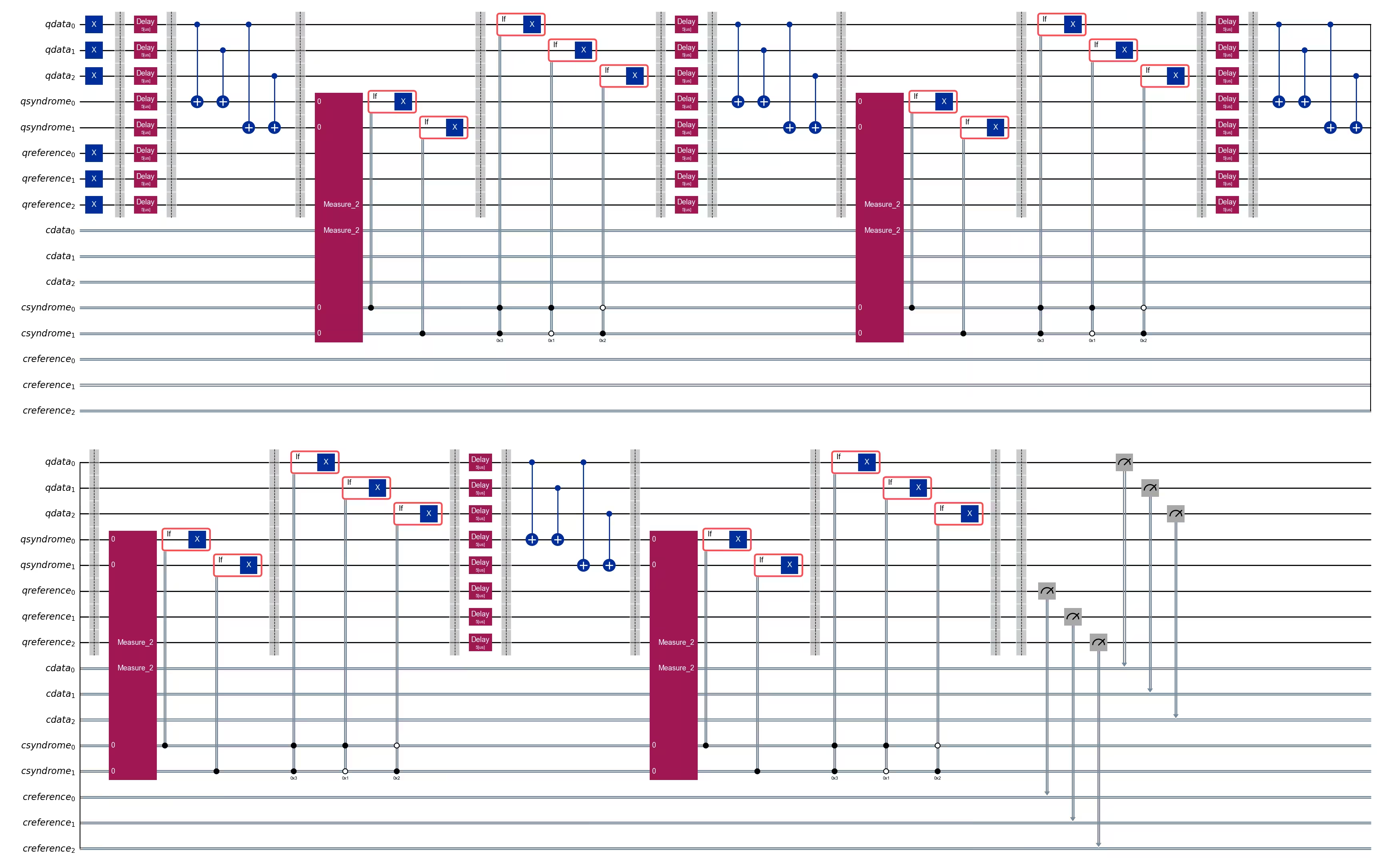
Codul bit-flip este unul dintre cele mai simple exemple de cod stabilizator. Protejează starea împotriva unei singure erori de inversare a bitului (X) pe oricare dintre Qubiții de codificare. Considerând acțiunea erorii de inversare a bitului , care mapează și pe oricare dintre Qubiții noștri, avem . Codul necesită cinci Qubiți: trei sunt folosiți pentru a codifica starea protejată (Qubiții de "date"), iar restul doi sunt folosiți ca Qubiți ancila pentru măsurarea stabilizatorilor.
Mai jos vei construi circuite care (1) pregătesc qubiții de date în starea logică , apoi (2) rulează mai multe cicluri de o întârziere de urmate de corectarea erorilor (inclusiv resetarea qubiților de sindrom), și (3) citesc starea qubiților de date.
Vom testa de asemenea durata de viață a stării fără a folosi corecția erorilor, incluzând trei qubiți de referință pe care îi pregătim în starea , îi lăsăm inactivi și apoi îi citim.
def build_qc(
    qreg_data,
    qreg_syndrome,
    creg_data,
    creg_syndrome,
    qreg_ref=None,
    creg_ref=None,
):
    """Build a typical error correction circuit"""
    if qreg_ref:
        return QuantumCircuit(
            qreg_data,
            qreg_syndrome,
            creg_data,
            creg_syndrome,
            qreg_ref,
            creg_ref,
        )
    else:
        return QuantumCircuit(
            qreg_data, qreg_syndrome, creg_data, creg_syndrome
        )

def encode_bit_flip(circuit, qreg_data, qreg_ref=None) -> QuantumCircuit:
    """Encode bit-flip. This is done by simply adding a cx"""

    for q in qreg_data:
        circuit.x(q)

    if qreg_ref:
        for q in qreg_ref:
            circuit.x(q)

    circuit.barrier()

    return circuit

def measure_syndrome_bit(
    circuit, qreg_data, qreg_syndrome, creg_syndrome, qreg_ref=None
):
    """
    Measure the syndrome by measuring the parity.
    We reset our ancilla qubits after measuring the stabilizer
    so we can reuse them for repeated stabilizer measurements.
    Because we have already observed the state of the qubit,
    we can write the conditional reset protocol directly to
    avoid another round of qubit measurement if we used
    the `reset` instruction.
    """
    circuit.cx(qreg_data[0], qreg_syndrome[0])
    circuit.cx(qreg_data[1], qreg_syndrome[0])
    circuit.cx(qreg_data[0], qreg_syndrome[1])
    circuit.cx(qreg_data[2], qreg_syndrome[1])
    circuit.barrier()

    for q_measure, c_measure in zip(qreg_syndrome, creg_syndrome):
        circuit.append(MidCircuitMeasure(), [q_measure], [c_measure])

    with circuit.if_test((creg_syndrome[0], 1)):
        circuit.x(qreg_syndrome[0])
    with circuit.if_test((creg_syndrome[1], 1)):
        circuit.x(qreg_syndrome[1])

    circuit.barrier()
    return circuit

def apply_correction_bit(circuit, qreg_data, creg_syndrome):
    """We can detect where an error occurred and correct our state"""
    with circuit.if_test((creg_syndrome, 3)):
        circuit.x(qreg_data[0])
    with circuit.if_test((creg_syndrome, 1)):
        circuit.x(qreg_data[1])
    with circuit.if_test((creg_syndrome, 2)):
        circuit.x(qreg_data[2])
    circuit.barrier()
    return circuit

def apply_final_readout(
    circuit, qreg_data, creg_data, qreg_ref=None, creg_ref=None
):
    """Read out the final measurements"""

    circuit.barrier()
    if qreg_ref:
        circuit.measure(qreg_ref, creg_ref)
    circuit.measure(qreg_data, creg_data)

    return circuit
def build_error_correction_sequence(
    num_cycles, cycles_per_circuit, nq_ref=3, delay=None
) -> QuantumCircuit:
    circuits = []
    reps = []

    qreg_data = QuantumRegister(3, name="qdata")
    qreg_syndrome = QuantumRegister(2, name="qsyndrome")
    creg_data = ClassicalRegister(3, name="cdata")
    creg_syndrome = ClassicalRegister(2, name="csyndrome")
    qreg_ref = QuantumRegister(nq_ref, name="qreference")
    creg_ref = ClassicalRegister(nq_ref, name="creference")

    circuit = build_qc(
        qreg_data,
        qreg_syndrome,
        creg_data,
        creg_syndrome,
        qreg_ref=qreg_ref,
        creg_ref=creg_ref,
    )
    circuit = encode_bit_flip(circuit, qreg_data, qreg_ref=qreg_ref)

    circuit_n = circuit.copy()
    circuit_n = apply_final_readout(
        circuit_n, qreg_data, creg_data, qreg_ref=qreg_ref, creg_ref=creg_ref
    )
    circuits.append(circuit_n)
    reps.append(0)

    for i in range(1, num_cycles + 1):
        if delay:
            circuit.delay(delay, unit="us")
            circuit.barrier()
        circuit = measure_syndrome_bit(
            circuit,
            qreg_data,
            qreg_syndrome,
            creg_syndrome,
            qreg_ref=qreg_ref,
        )
        circuit = apply_correction_bit(circuit, qreg_data, creg_syndrome)
        circuit_n = circuit.copy()
        if i % cycles_per_circuit == 0:
            circuit_n = apply_final_readout(
                circuit_n,
                qreg_data,
                creg_data,
                qreg_ref=qreg_ref,
                creg_ref=creg_ref,
            )
            circuits.append(circuit_n)
            reps.append(i)

    return circuits, np.array(reps)

num_cycles = 40
cycles_per_circuit = 4
nq_ref = 3
circuits, rep_array = build_error_correction_sequence(
    num_cycles, cycles_per_circuit, nq_ref=3, delay=5
)
circuits[1].draw(output="mpl", cregbundle=False, fold=50)
Pasul 2: Optimizează problema pentru execuție cuantică hardware
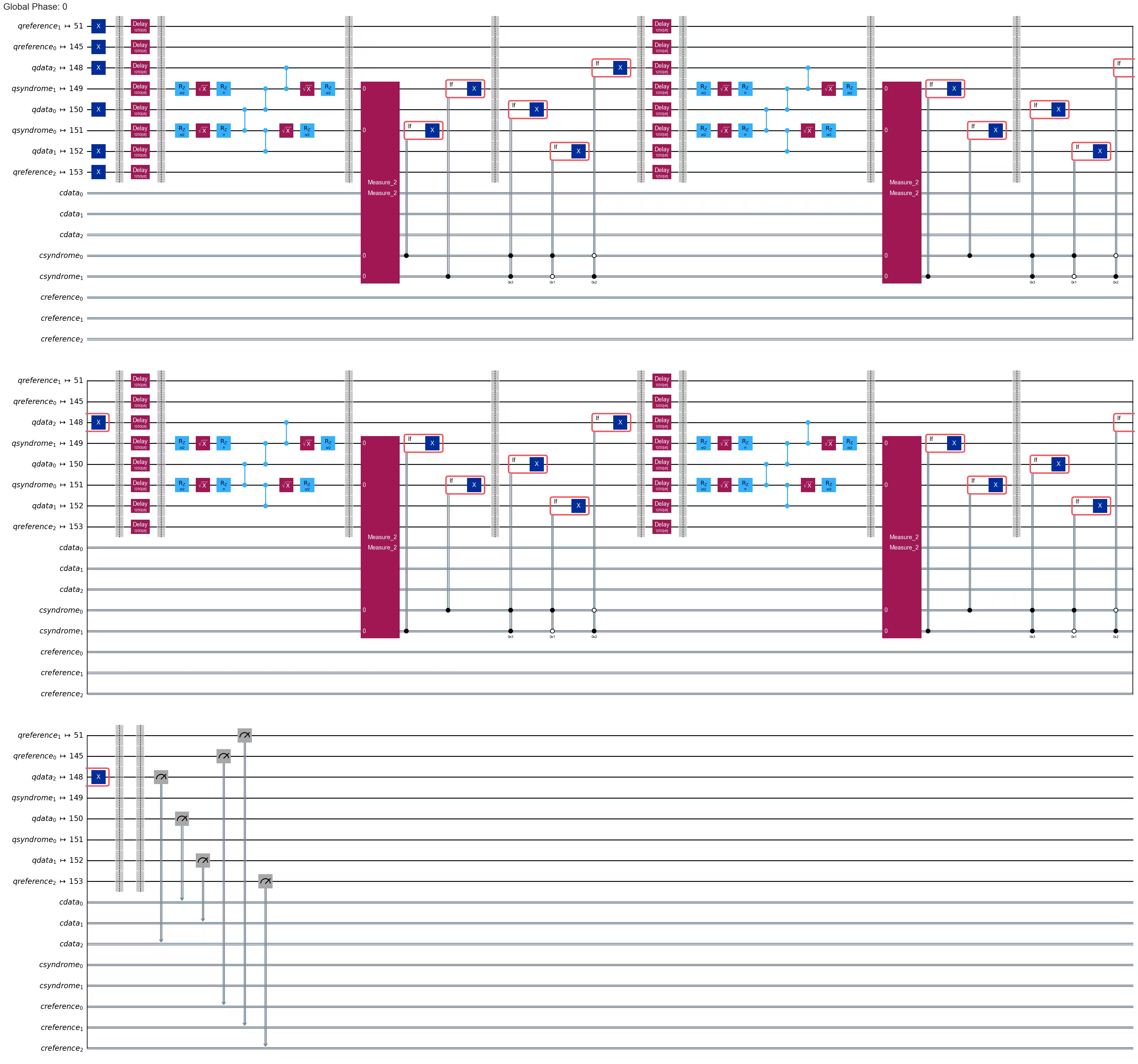
Pentru a reduce timpul total de execuție a lucrărilor, primitivele Qiskit acceptă doar circuite și observabile care sunt conforme cu instrucțiunile și conectivitatea suportate de sistemul țintă (denumite circuite și observabile ISA — instruction set architecture). Află mai multe despre transpilare.
Generează circuite ISA
Vom începe prin a găsi un layout inițial (adică o selecție de qubiți fizici pe care să mapăm circuitele noastre) prin transpilarea celui mai lung dintre circuitele noastre folosind managerul de pași presetat cu nivelul de optimizare 3.
from qiskit.transpiler.preset_passmanagers import generate_preset_pass_manager

pm = generate_preset_pass_manager(backend=backend, optimization_level=3)
isa_circuit_ref = pm.run(circuits[-1])
init_layout = isa_circuit_ref.layout.initial_index_layout(
    filter_ancillas=True
)
print(init_layout)
[56, 44, 62, 43, 63, 22, 48, 67]
Pentru qubiții de referință cu care vom compara memoria noastră cuantică logică, îi vom alege să fie cei mai buni qubiți disponibili în ceea ce privește timpul de coerență de amortizare a amplitudinii ().
# get all qubits ordered by T1
t1_data = []
for i in range(backend.num_qubits):
    try:
        t1_us = backend.properties().t1(i) * 1e6
    except Exception:
        t1_us = 0.0
    t1_data.append((i, t1_us))

t1_data_sorted = sorted(t1_data, key=lambda x: x[1], reverse=True)

# exclude the qubits we have already mapped the error correcting code to
t1_data_sorted = [
    t1_data for t1_data in t1_data_sorted if t1_data[0] not in init_layout[:5]
]

# use the best qubits in terms of T1 for the reference qubits
init_layout = init_layout[:5] + [t1_data[0] for t1_data in t1_data_sorted[:3]]
print(init_layout)
[56, 44, 62, 43, 63, 143, 131, 31]
# These are the resulting T1 times
properties = backend.properties()
print("Amplitude damping decoherence times for code data qubits:")
for q in init_layout[:3]:
    t1 = properties.t1(q)
    print(f"qubit {q}: T1 = {t1 * 1e6:.0f} mus")

print("\nAmplitude damping decoherence times for reference qubits:")
for q in init_layout[-3:]:
    t1 = properties.t1(q)
    print(f"qubit {q}: T1 = {t1 * 1e6:.0f} mus")
Amplitude damping decoherence times code data qubits:
qubit 56: T1 = 322 mus
qubit 44: T1 = 263 mus
qubit 62: T1 = 290 mus

Amplitude damping decoherence times reference qubits:
qubit 143: T1 = 442 mus
qubit 131: T1 = 410 mus
qubit 31: T1 = 401 mus
# now we transpile all circuits to this initial layout; this way each circuit is run on the same qubits and we can make a fair comparison
pm = generate_preset_pass_manager(
    backend=backend,
    optimization_level=3,
    initial_layout=init_layout,
)
isa_circuits = pm.run(circuits)
isa_circuits[1].draw("mpl", cregbundle=False, fold=50)
Pasul 3. Execută folosind primitivele Qiskit
sampler = Sampler(mode=backend)

sampler.options.environment.job_tags = ["TUT-REPCODE"]
sampler.options.max_execution_time = 600  # this workload is expected to be under 10s, but it is generally a good habit to set a max execution time (here 600s = 10m)
job = sampler.run(isa_circuits, shots=1000)
print(job.job_id())
job.status()
'DONE'
Pasul 4: Post-procesează și returnează rezultatul în formatul clasic dorit
Vom compara acum ratele de eroare vs. timp între memoria logică folosind codul de repetiție cu 3 qubiți pe de o parte, și qubiții de referință individuali, necodificați, pe de altă parte.
results = job.result()
def correct_counts(counts_dict):
    """
    Corrects the measured logical qubit encoded in the repetition code using majority vote
    """

    result = {"000": 0, "111": 0}
    for bitstring, count in counts_dict.items():
        key = "111" if bitstring.count("1") > 1 else "000"
        result[key] += count
    return result

accuracy = []  # logical qubit
accuracies_ref = np.zeros(
    (len(results), nq_ref)
)  # accuracies on individual reference qubits

for n, pub_result in enumerate(results):
    # logical accuracy (one minus error probability) for active error correction with repetition code
    counts = pub_result.data.cdata.get_counts()
    shots = sum(counts.values())
    counts_corrected = correct_counts(counts)
    accuracy.append(counts_corrected.get("111", 0) / shots)

    # accuracy for individual physical reference qubits without any error correction
    for i in range(nq_ref):
        counts = pub_result.data.creference.slice_bits(i).get_counts()
        accuracies_ref[n, i] = counts.get("1", 0) / shots

accuracy = np.array(accuracy)
def error_proba_t1(N, t1):
    """
    Exponential fitting function for amplitude damping vs. number of cycles
    """

    t_cycle = 7.3e-6  # approximate time per cycle = 5 mus delay + 2.3 mus for error correction
    return 1 - np.exp(-t_cycle * N / t1)

fig, ax = plt.subplots(1, 1, figsize=(15, 5))
ax.plot(
    rep_array, (1.0 - accuracy) * 100.0, "ko-", linewidth=3, label="rep code"
)

for i in range(nq_ref):
    accuracy_1q = accuracies_ref[:, i]
    if i == 0:
        ax.plot(
            rep_array,
            (1.0 - accuracy_1q) * 100.0,
            "go-",
            linewidth=1,
            label="1q reference",
        )
    else:
        ax.plot(rep_array, (1.0 - accuracy_1q) * 100.0, "go-", linewidth=1)

params_bf, pcov = curve_fit(
    error_proba_t1, rep_array, 1.0 - accuracy, bounds=([0, 5e-3])
)
t1_bf = params_bf[0]
print(f"Best-fit effective T1 = {t1_bf * 1e6:.0f} us")
error_prob_bf = error_proba_t1(
    rep_array, t1_bf
)  # np.array([1 - np.exp(-t_cycle * nt/t1) for nt in rep_array])
ax.plot(rep_array, error_prob_bf * 100.0, "k--", linewidth=1)

ax.set_xlabel("error correction rounds")
ax.set_ylabel("error [%]")
ax.set_ylim(bottom=0)
ax.legend(fontsize=15);
Best-fit effective T1 = 1397 us
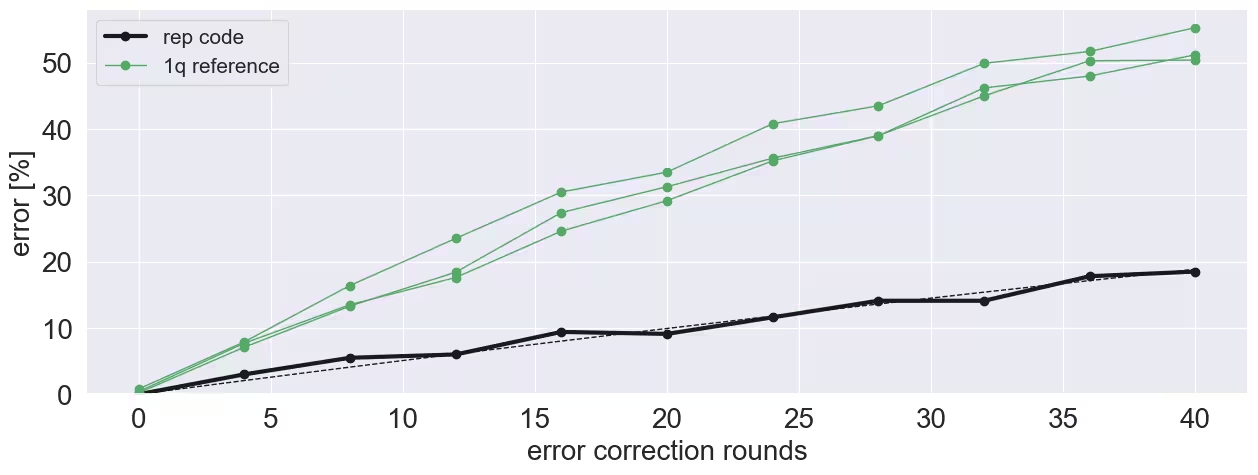
Observăm clar o durată de viață îmbunătățită a stării , chiar comparativ cu cei mai buni qubiți fizici (necodificați). Totuși, reține că acest experiment corectează doar un singur tip de eroare, și anume bit-flip-urile. Poți îmbunătăți durata de viață a qubitului logic? Ai putea explora optimizarea timpului de întârziere, scalarea dimensiunii codului de repetiție dincolo de etc.
Pași următori
Dacă ai găsit această lucrare interesantă, ar putea să te intereseze următoarele materiale:
-
Cursul Fundamentele corecției erorilor cuantice - află mai multe despre corecția erorilor cuantice
-
Tutorialul Detectarea erorilor cu overhead redus folosind coduri spațiu-timp - învață cum să folosești verificări Pauli pentru a detecta erori și a post-selecta eșantioane